
2026 Financial Year Market Update
Welcome to Barwon Financial Planning’s second quarterly update for 2026.
In this edition, our Geelong financial advisers provide insights into the latest market movements and economic themes shaping investment decisions in the year ahead. We also cover important financial planning updates, including legislated superannuation contribution changes, Payday Super, and personal income tax changes from July.
Finally, we explore proposed reforms to capital gains tax and negative gearing, and what these changes may mean for investors, property owners and long term wealth planning.

While global markets have remained relatively resilient, we continue to monitor several challenges facing the Australian economy. Economic growth has been supported in recent years by significant government spending, helping to maintain employment and economic activity through a period of higher interest rates and cost-of-living pressures. However, this level of fiscal support has also contributed to inflationary pressures, making it more difficult for the Reserve Bank of Australia to confidently move interest rates lower.
Housing remains another area of focus. Property has long been a cornerstone of wealth creation for many Australians, yet affordability concerns and growing intergenerational wealth disparities have prompted ongoing policy discussions regarding housing supply, taxation, and market regulation. While the long-term direction of these policies remains uncertain, any significant changes have the potential to influence both property values and investor behaviour.
More broadly, Australia faces the challenge of balancing government expenditure, taxation, productivity growth, and private sector investment. Maintaining this balance will be important to ensure the economy remains competitive, innovative, and resilient in the face of both domestic and international challenges.
International developments also continue to warrant close attention. In particular, disruptions to global energy supply chains, including concerns surrounding shipping routes through the Strait of Hormuz, have placed upward pressure on energy prices and inflation. While markets generally expect any interruptions to be temporary, prolonged disruptions could have broader implications for fuel costs, transportation expenses, and global economic growth.
Despite these challenges, Australia continues to benefit from a strong financial system, low unemployment by historical standards, substantial natural resources, and close economic ties with many of the world's fastest-growing regions. These factors provide a solid foundation for long-term economic growth, even as policymakers navigate a complex and evolving economic environment.

Investment Opportunities And Market Outlook For 2026
While there are undoubtedly challenges facing both the Australian and global economies, it is important to remember that investment markets are forward-looking. Markets often begin recovering well before economic conditions fully improve, which is why maintaining a long-term perspective remains so important.
As we move through the remainder of 2026, we believe several factors could provide support for asset prices and investment returns.
Firstly, while inflation remains elevated, most central banks continue to focus on returning inflation towards their long-term targets. Although recent geopolitical events have placed upward pressure on energy prices, inflation is still expected to moderate over time as supply chains normalise, demand softens, and previous interest rate increases continue to work their way through the economy. The Reserve Bank of Australia expects inflation pressures to gradually ease over the coming years, even though short-term volatility remains possible.
Secondly, corporate balance sheets generally remain healthy and employment levels across many developed economies continue to be resilient. While economic growth may be slower than many would like, businesses have proven remarkably adaptable through a period characterised by higher inflation, rising interest rates, geopolitical tensions and shifting consumer behaviour. This resilience continues to support company earnings and long-term shareholder value.
We also remain constructive on the long-term impact of artificial intelligence and technological innovation. While recent market enthusiasm has largely focused on technology companies, the real opportunity may emerge as AI is adopted across broader sectors of the economy. Improvements in productivity, automation and efficiency have the potential to support economic growth and corporate profitability for many years to come.
Within Australia, we continue to see opportunities across high-quality companies with strong balance sheets, sustainable earnings and pricing power. We also believe that infrastructure, healthcare, technology and selected industrial businesses remain well positioned to benefit from long-term structural growth trends.
Looking further ahead, history shows that periods of uncertainty often create opportunities for patient investors. Political cycles, economic slowdowns, inflation concerns and geopolitical events have all tested markets in the past, yet quality businesses and diversified portfolios have consistently demonstrated an ability to adapt and grow over time.
While we expect market volatility to remain a feature of the investment landscape throughout 2026, we remain cautiously optimistic. Global innovation continues to accelerate, businesses remain adaptable, and many asset classes now offer more attractive valuations and income opportunities than they have in recent years. For long-term investors, we believe the foundations remain in place for continued wealth creation, provided portfolios remain diversified and investment decisions remain focused on long-term objectives rather than short-term market noise.
2026 Superannuation Changes: Contribution Caps And Payday Super

Contribution Caps
As discussed in the last quarterly newsletter the increase in the contribution caps for the 2026-27 financial year has been legislated. The increased annual concessional cap is now $32,500 and the annual non-concessional cap (after-tax) will rise to $130,000.
Payday Super Guarantee Legislation
From 1 July 2026, Australian employers are required to pay Superannuation Guarantee (SG) contributions at the same time as salary and wages are paid. Contributions must be received by the employee’s super fund within seven business days of the day in which the employee is paid.
Failure to pay within the timeframe means the employer will be liable for the Super Guarantee Charge (SGC), incurring a penalty for unpaid or underpaid SG payments.
2026 Personal Income Tax Changes Explained
From 1 July 2026, the marginal tax rate on income between $18,201 and $45,000 decreases from 16% to 15%. This provides every Australian taxpayer earning above $18,200 with an automatic tax reduction.
Maximum annual saving = $268
Who benefits: Anyone earning over $18,200 because the 15% rate applies to the entire $18,201-$45,000 tax bracket.
Example: You earn $40,000 in assessable income for the 2026/27 Financial Year.
Step 1 - Determine the portion taxed at the reduced rate
40,000 - 18,200 = 21,800 (taxable at 15%)
Step 2 - Compare tax payable before and after the change

Annual saving: $3,488 – $3,270 = $218
If you earn $45,000 or more, you will receive the maximum saving of $268.
Proposed Federal Budget Changes
Capital Gains Tax Reform
The new Australian federal budget discusses a proposal to change how capital gains are taxed from 1 July 2027. Instead of receiving the current 50% CGT (capital gains tax) discount on assets held for more than 12 months, it is proposed that investors will adjust their purchase cost for inflation and pay tax on the remaining gain.
Example: An investor buys shares for $100,000 and later sells them for $200,000
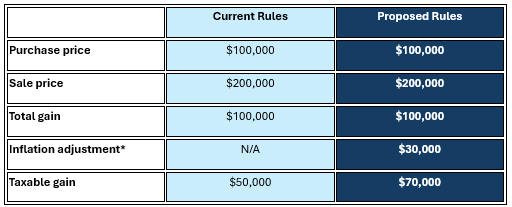
Existing gains accrued before 1 July 2027 will continue to be dealt with under the current 50% CGT discount on assets held for more than 12 months, relating to the period prior to 1 July 2027. Any gains after this period will apply the proposed indexation method. A minimum of 30% tax on accessible capital gains will apply.
* Inflation adjustment is an estimated calculation for example purposes only.
Proposed Negative Gearing Changes for Property Investors
Another proposal from the federal budget relates to changes to negative gearing from 1 July 2027.
Under the proposal, investors who purchase an established residential investment property after 7:30pm AEST on 12 May 2026 will no longer be able to offset rental losses against other income such as salary and wages. Instead, any losses will generally only be able to be offset against future residential rental income or capital gains from residential property.
Existing investment properties held before Budget night, and eligible new-build properties, are expected to remain subject to the current rules. The measure has not yet been legislated.
Example: An investor purchases an established residential investment property after Budget night and records:
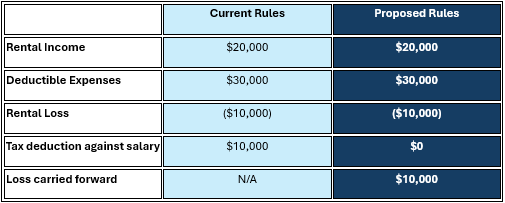
Under the current rules, the investor may be able to use the $10,000 rental loss to reduce their taxable salary income for the year.
Under the proposed rules, the $10,000 loss cannot be offset against salary income. Instead, it would generally be carried forward and used against future residential rental income or capital gains from residential property.
Important: As a transitional measure, established residential properties acquired after Budget night can continue to be negatively geared under the current rules until 30 June 2027. The proposed restrictions are scheduled to commence from 1 July 2027.
Need advice on how these changes could impact your financial plan?
Speak with the team at Barwon Financial Planning for personalised advice.